
MEPCO Net Metering 2026
Electricity costs in Pakistan continue to surge, and power supply shortages remain a persistent issue for households and businesses across South Punjab. Installing a solar power system has become the most practical way to lower monthly utility expenses. However, if you are planning to install solar panels in 2026—or already have an active green meter—the regulatory landscape has undergone significant changes.
In February 2026 MEPCO Net Metering, the National Electric Power Regulatory Authority (NEPRA) replaced the decade-old net metering framework with a new Net Billing System under the NEPRA Prosumer Regulations 2026. This comprehensive guide breaks down how MEPCO net metering works today, what the new rules mean for your monthly savings, how to apply, and how to verify your duplicate bills online.
What Is MEPCO Net Metering (Net Billing)?
Net metering is an arrangement that allows consumers who generate solar energy to export surplus power back to the grid operated by the Multan Electric Power Company (MEPCO). A specialized bidirectional meter (Green Meter) records two key parameters:
- Import Units: The electricity you pull from the MEPCO grid when your solar system isn’t producing energy (e.g., at night or during overcast weather).
- Export Units: The excess electricity generated by your solar system during daytime hours that flows back into the grid.
The Major 2026 Policy Shift: Net Metering vs. Net Billing
Under NEPRA’s updated guidelines implemented on February 9, 2026, new solar connections operate under a Net Billing model rather than a unit-for-unit swap.
| Feature | Old Framework (Pre-Feb 2026) | New Framework (Post-Feb 2026) |
| Billing Mechanism | 1:1 Unit Swap (Units directly offset each other) | Net Billing (Financial calculation based on separate rates) |
| Buyback Rate (Export) | ~Rs. 25–26 per unit | ~Rs. 10–11 per unit |
| Import Rate (Grid) | Standard Tariff (Rs. 37 to 55+ per unit) | Standard Tariff (Rs. 37 to 55+ per unit) |
| Agreement Term | 7 Years | 5 Years |
Key Takeaway for Homeowners: Oversizing your solar array purely to sell power back to the grid is no longer financially optimal. The primary financial benefit now comes from self-consumption—using your solar power during the day to avoid paying high retail grid tariffs (Rs. 37–55+ per unit).
Are Existing Net Metering Consumers Grandfathered In?
Yes. If your net metering agreement with MEPCO was officially signed prior to February 9, 2026, your existing contract terms remain protected.
- Contract Protection: Grandfathered users retain their original 1:1 swapping mechanism and buyback rates (Rs. 25–26/unit) until their specific contractual agreement expires.
- Important Caution: If you modify your system capacity (e.g., adding more solar panels or upgrading your inverter), your legacy agreement will terminate, and your connection will be migrated to the new Net Billing framework.
- Pending Applications: Applications submitted before February 8, 2026, are cleared under the legacy rules.

Step-by-Step Guide: How to Apply for MEPCO Net Metering
Follow these steps to submit a prosumer connection application under the current rules:
Step 1: Verify System Capacity and Load
Your solar system capacity must not exceed the approved sanctioned load of your MEPCO connection.
Step 2: Hire an AEDB-Certified Solar Installer
NEPRA and MEPCO do not accept applications directly from individual consumers. You must partner with an Alternative Energy Development Board (AEDB) certified installer. Applications processed through non-certified companies will be rejected.
Step 3: Prepare Required Documentation
Assemble the following documents:
- Valid CNIC copies of the property owner (front and back)
- Paid copies of your MEPCO electricity bills from the last 3 months
- Proof of property ownership (Registry deed, Fard, or lease agreement with NOC)
- Technical specification sheets for the solar panels and inverter
- Single-Line Diagram (SLD) prepared and certified by a registered electrical engineer
- Undertaking/Affidavit on an Rs. 100 stamp paper confirming compliance with NEPRA Prosumer Regulations 2026
Step 4: Application Submission & Site Inspection
Your certified installer submits the application package to your local MEPCO Subdivision or Executive Engineer (XEN) office. Following document verification, a MEPCO technical team performs an on-site inspection to review wiring, earthing, inverter protection settings, and safety equipment.
Step 5: Agreement Execution & Meter Installation
Upon passing the site inspection, MEPCO signs a 5-year prosumer agreement with you. The distribution company then installs the bidirectional meter. The entire process typically takes 45 to 75 days.
Costs and Single-Phase Connection Upgrades
- Processing Fee: For residential installations (up to 10 kW), MEPCO processing fees range between PKR 15,000 and 20,000.
- Bidirectional Meter Fee: Green meters cost approximately PKR 8,000 to 15,000.
- Phase Conversion Requirement: Net metering requires a Three-Phase connection. If your premises currently uses a Single-Phase meter, you must apply for a load enhancement and meter conversion first. Phase upgrades generally incur an additional cost of PKR 40,000 to 70,000.
How to Verify Your MEPCO Solar Bill Online
After your bidirectional meter is operational, it is important to cross-check your monthly statement to ensure import and export units are billed accurately.
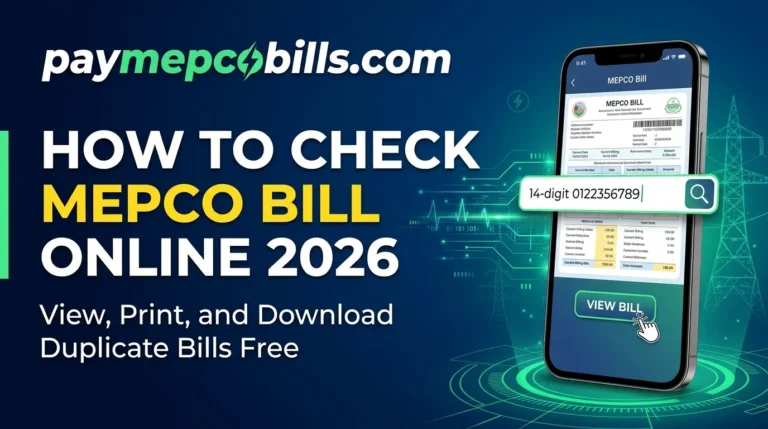
You can check and download your duplicate MEPCO bill online for free by visiting paymepcobills.com. Simply enter your 14-digit Reference Number or Consumer ID to view your bill breakdown, including current reading dates, unit credits, and applied tax tariffs.
FAQs for MEPCO Net Metering
Conclusion
The shift from traditional net metering to net billing in 2026 marks a major policy update for solar consumers across Multan and South Punjab. While reduced buyback rates mean grid export is less lucrative than before, adopting MEPCO Net Metering under the new guidelines remains one of the smartest investments to combat rising electricity tariffs and frequent power outages. By sizing your solar system to match your daytime electricity usage rather than overproducing, you can maximize your monthly savings and achieve long-term energy independence.

One Comment