

MEPCO Tariff Calculator Online Guide 2026
Understanding monthly electricity bills in South Punjab requires navigating complex slab rates, fuel price adjustments, taxation levies, and peak-hour unit surges. Multan Electric Power Company applies NEPRA-approved consumer tariffs that vary significantly based on consumption thresholds and category classifications. Utilizing a MEPCO Tariff Calculator Online enables residential, commercial, and agricultural consumers to estimate monthly billing costs accurately before official physical bills arrive. By simply inputting total units consumed, property owners can break down base charges, fixed costs, government taxes, and variable duties in advance. This comprehensive guide explains current tariff schedules, step-by-step billing calculations, unit slab dynamics, and practical tips to reduce monthly power expenses.
Understanding NEPRA Tariff Slabs and Category Rates
Utility bills in Pakistan operate on progressive slab structures, meaning the cost per unit increases as monthly consumption crosses designated thresholds.
Key billing categories and tariff factors include:
- Protected Residential Consumers: Consumers using consistently under 200 units per month for six consecutive months qualify for subsidized baseline rates.
- Unprotected Residential Consumers: Accounts exceeding 200 units in any month enter unprotected slabs, where per-unit prices jump progressively at 300, 400, and 500-unit tiers.
- Commercial and Industrial Tariffs: Flat or two-part tariffs applying fixed capacity charges per kilowatt alongside higher per-unit energy rates.
- Agricultural Tube-Well Tariffs: Specialized subsidized rates designated for agricultural pumping connections across farming regions.
Knowing your connection category helps you interpret digital calculation results with high accuracy.

How to Calculate Your Electricity Bill Step-by-Step
Estimating your monthly power expenditure manually or through digital utility estimation tools requires applying specific mathematical formulas mandated by power regulators.
Follow these primary calculation steps:
Step 1: Record Total Monthly Units Consumed
Subtract your previous month’s meter reading from the current meter reading shown on your digital electric meter to find your net kilowatt-hours (kWh).
Step 2: Apply Unit Slab Rates
Multiply consumed units within each respective slab tier by the official NEPRA per-unit rate assigned to that category.
Step 3: Factor in Variable Adjustments
Add monthly variable surcharges including Fuel Price Adjustment (FPA) and Quarterly Tariff Adjustment (QTA) announced by regional energy authorities.
Step 4: Include Fixed Taxes and Duties
Calculate government taxes such as Electricity Duty (ED), General Sales Tax (GST), TV Fee, and Advance Income Tax where applicable.
Accessing a reliable MEPCO Tariff Calculator Online automates these intricate mathematical steps instantly, eliminating manual calculation errors for account holders.
Breakdown of Taxes and Surcharges on Your Monthly Bill
A significant portion of your total payable utility bill consists of statutory government taxes, regulatory surcharges, and financing levies added to the core variable energy charges.
Primary billing surcharges include:
- Fuel Price Adjustment (FPA): Monthly fluctuating costs reflecting variations in global fuel prices used for thermal and gas power generation.
- General Sales Tax (GST): A standard statutory percentage tax applied to the total energy charges and fuel adjustment totals.
- Financing Surcharge (FC Surcharge): A standardized per-unit levy designated to cover national power sector debt servicing and transmission upgrades.
- Electricity Duty (ED) & TV Fee: Municipal electricity taxes alongside the fixed monthly PTV service fee added to domestic bills.
Understanding these mandatory billing components explains why total amounts due often exceed basic unit rates multiplied by consumed units.
Read More About MEPCO New Electricity Meter Connection Fee 2026
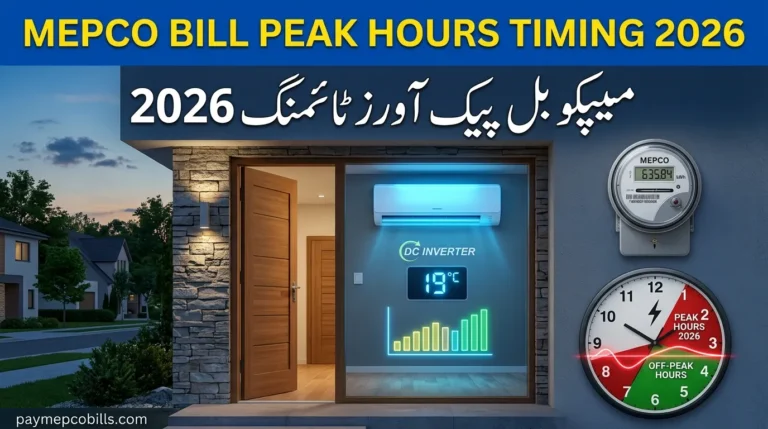
How Peak and Off-Peak Hours Impact Your Billing Total
Three-phase digital meters and time-of-use (TOU) accounts record electricity consumption across separate peak and off-peak time bands.
Key Time-of-Use principles include:
- Higher Peak Hour Rates: Electricity consumed during designated evening peak hours incurs significantly higher per-unit rates due to regional grid demand surges.
- Lower Off-Peak Rates: Operating heavy appliances during off-peak hours reduces total billing costs substantially.
- Seasonal Peak Timing Variations: Peak hour schedules adjust between summer and winter seasons according to daylight shifts.
Using a MEPCO Tariff Calculator Online configured for Time-of-Use tariffs allows commercial and heavy domestic consumers to model cost savings achieved by shifting appliance usage to off-peak periods.
Read More About MEPCO Smart Meter Installation 2026 Guide
Practical Tips to Reduce Monthly Unit Consumption
Managing household and commercial power demand proactively prevents accounts from escalating into higher, expensive tariff slabs.
Implement these effective energy-saving practices:
- Monitor Daily Meter Readings: Track daily meter numbers to detect high power draw early and adjust AC usage before crossing into higher unit slabs.
- Shift Heavy Loads Outside Peak Hours: Run water pumps, iron appliances, washing machines, and heavy motors during off-peak morning and early afternoon hours.
- Upgrade to Inverter Technology: Replace old appliances with energy-efficient inverter air conditioners, refrigerators, and LED lighting fixtures.
- Explore Rooftop Solar Options: Install solar PV systems with net metering to offset grid energy imports and reduce monthly unit tallies permanently.
Following these practical management steps alongside utilizing a MEPCO Tariff Calculator Online gives consumers full control over their monthly utility budgets.



One Comment