
MEPCO Load Shedding Schedule 2026
MEPCO Load Shedding affects millions of households, businesses, and agricultural consumers across South Punjab every single day. Managing daily life in cities like Multan, Bahawalpur, Dera Ghazi Khan, Rahim Yar Khan, and Sahiwal becomes significantly easier when you have clear and accurate information about power outage timings. Because electricity distribution is managed at the feeder level rather than through broad city-wide announcements, understanding how MEPCO Load Shedding is structured helps you plan your day around routine power interruptions.
This detailed guide explains how MEPCO Load Shedding works in 2026, provides step-by-step methods to check your feeder schedule online, highlights district-level patterns, and covers essential procedures for reporting unexpected transformer faults and line outages.
Why Does MEPCO Load Shedding Happen?
To understand MEPCO Load Shedding, it is essential to understand the distinction between power generation and distribution. Multan Electric Power Company (MEPCO) does not generate electricity directly. Instead, it purchases bulk electricity from the national grid and distributes it across its massive network of high-voltage transmission lines, grid stations, and localized distribution feeders.
When total national power demand exceeds the available power supply, the system operator directs distribution companies to cut consumption. Consequently, MEPCO Load Shedding is implemented to prevent complete grid collapse.
Several key factors contribute to daily MEPCO Load Shedding:
- National Generation Shortfall: During peak summer months, widespread use of air conditioners drives overall demand higher than current generation capacity.
- Feeder Transmission Losses: Feeders with high electricity theft or aging infrastructure suffer higher line losses, triggering longer MEPCO Load Shedding windows.
- Bill Recovery Rates: MEPCO enforces a differential policy where areas with low bill collection rates face increased MEPCO Load Shedding as a policy measure.
- Scheduled Grid Maintenance: Periodic repairs on 132KV grid stations and distribution transformers require temporary power cuts separate from daily MEPCO Load Shedding.
- Weather & Technical Disturbances: Sudden monsoon storms, dust, and high heat lead to trips and localized line faults.
Read More About MEPCO Duplicate Bill Online: View, Download & Print Guide (2026)
How MEPCO Load Shedding Is Categorized by Feeder
A common misconception is that entire cities share the same outage timetable. In reality, MEPCO Load Shedding is assigned specifically to individual feeders based on line loss percentages and overall bill recovery. Two neighboring streets connected to different distribution lines can experience completely different power outage schedules.
| Feeder Category | Bill Recovery Percentage | Average Daily Outage Duration |
| High Recovery / Low Loss | Above 90% | 0 to 2 Hours |
| Medium Recovery | 70% to 90% | 2 to 6 Hours |
| Low Recovery / High Loss | Below 70% | 8 to 12+ Hours |
Because high-loss areas receive extended outage hours, community bill payment directly impacts the total duration of MEPCO Load Shedding in any given area.
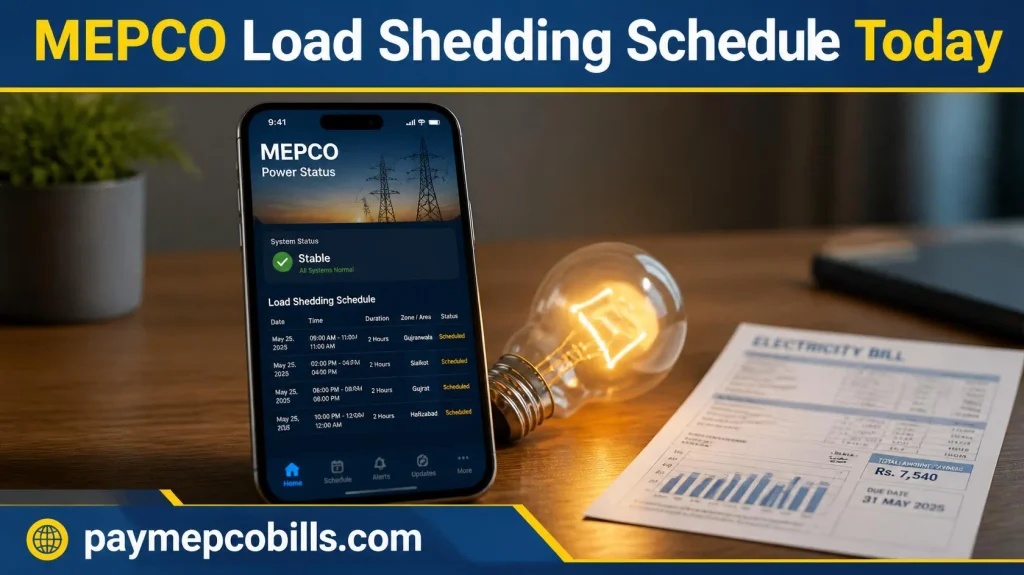
4 Easy Ways to Check MEPCO Load Shedding Timings Today
Checking random social media groups or unverified image forwards often leads to inaccurate information. To find exact timings for MEPCO Load Shedding, use these official, direct verification methods:
Method 1: Check CCMS Portal via Reference Number
The Centralized Complaint Management System (CCMS) offers real-time feeder details directly from the operational database:
- Open your internet browser and navigate to the official CCMS Feeder Details webpage.
- Locate the 14-digit reference number printed at the top right section of your paper electricity bill.
- Type the 14 digits into the search box and click Submit.
- The screen will display your precise feeder name, grid station details, and active Load Shedding timing blocks.
Note: If your reference number is not accessible, you can enter your 10-digit Consumer ID instead.
Read More About MEPCO Net Metering 2026
Method 2: Official MEPCO Portal
- Visit the official MEPCO web portal.
- Access the Consumer Services / Load Management section.
- Choose your administrative circle (e.g., Multan, Bahawalpur, Sahiwal, DG Khan, or Rahim Yar Khan).
- Locate your feeder name from the published division list to view routine Load Shedding rotations and scheduled maintenance notices.
Method 3: Call 118 Helpline
For immediate manual checking or when power stays off past the regular schedule:
- Direct Helpline: Call 118 (Available 24 hours a day, 7 days a week)
- Toll-Free Line: Call 0800-63726
Share your 14-digit reference number with the call operator to confirm if your area is undergoing routine Load Shedding or experiencing an unscheduled emergency fault.
Method 4: SMS Service via 8118
You can quickly query account information by sending your 14-digit reference number through a mobile text message to 8118. The automated system responds with account details and current Load Shedding updates for your registered connection.
District-Wise Load Shedding Breakdown
MEPCO covers 13 primary districts across South Punjab. Outage durations vary significantly across urban centers, industrial areas, and rural agricultural belts:
Multan District
As the commercial hub and headquarters of the company, urban residential areas in Multan City—such as Gulgasht Colony, Wapda Town, and Cantt—generally experience around 3 to 6 hours of Load Shedding. However, peri-urban areas and rural feeders along Shujabad Road face 7 to 10 hours daily.
Bahawalpur & Bahawalnagar Circles
Urban zones in Bahawalpur City and Satellite Town see 5 to 8 hours of daily power cuts. Remote rural agricultural feeders across Chishtian, Ahmedpur East, and Fort Abbas experience extended Load Shedding reaching 8 to 12 hours during high-demand agricultural months.
Dera Ghazi Khan & Rajanpur Circles
Covering vast geographic areas near the Sulaiman Range, DG Khan City experiences around 5 to 8 hours of power cuts. Remote or border areas including Taunsa Sharif, Rajanpur, and Rojhan frequently face extended Load Shedding exceeding 10 hours due to lengthy distribution lines and high loss ratios.
Rahim Yar Khan District
Commercial hubs in Rahim Yar Khan and Sadiqabad average 4 to 8 hours of daily cuts. Rural tube well feeders across Khanpur and Liaquatpur experience longer MEPCO Load Shedding windows during peak irrigation periods.
Sahiwal & Pakpattan Districts
Sahiwal maintains relatively high bill recovery rates, resulting in moderate Load Shedding averaging 4 to 6 hours in urban residential sectors and 6 to 8 hours in surrounding agricultural areas.
Understanding Peak Hours vs. Load Shedding
Many electricity consumers confuse peak pricing hours with routine outages. These two concepts affect your monthly bill differently:
- Load Shedding: Complete interruption of electric current. Zero electricity is consumed because appliances cannot run.
- Peak Hours: Power supply remains active, but electricity consumed during this time frame is billed at a higher per-unit tariff (applicable to Time-of-Use and smart meters).
Seasonal Peak Hours Schedule
| Season | Operational Months | Peak Hours Time Slot |
| Summer | June to August | 7:00 PM – 11:00 PM |
| Autumn | September to November | 6:00 PM – 10:00 PM |
| Winter | December to February | 5:00 PM – 9:00 PM |
| Spring | March to May | 6:00 PM – 10:00 PM |
Operational Tip: Avoiding heavy electrical equipment—such as air conditioners, water pumps, and electric irons—during peak hours keeps your overall billing manageable, even during periods of frequent Load Shedding.
Daily Outages vs. Planned Maintenance Shutdowns
It is important to recognize the difference between daily rotational power management and planned engineering work:
- Daily Rotational Load Shedding: Follows predictable, repeating time blocks published on the CCMS portal to manage supply deficits.
- Planned Maintenance Shutdowns: Temporary power shutdowns scheduled in advance by MEPCO engineers for transformer repairs, HT line maintenance, or grid upgrades. These maintenance notices are published separately on the official company portal.
How to Report Unscheduled Outages and Feeder Faults
If the power remains off for more than 30 minutes beyond your expected Load Shedding window, an unscheduled fault may have occurred on your feeder. Take these steps to report the issue:
- Call 118: Provide your reference number and feeder name to register an official fault ticket.
- Send SMS to 8118: Text your 14-digit reference number and a brief description of the outage.
- Register Online: Log an outage ticket through the official CCMS complaint section.
- Safety First: If you spot fallen wires, sparking transformers, or damaged pole equipment after a storm, keep distance and report the hazardous condition immediately to 118.





One Comment