MEPCO Commercial Bill Check Online Guide 2026
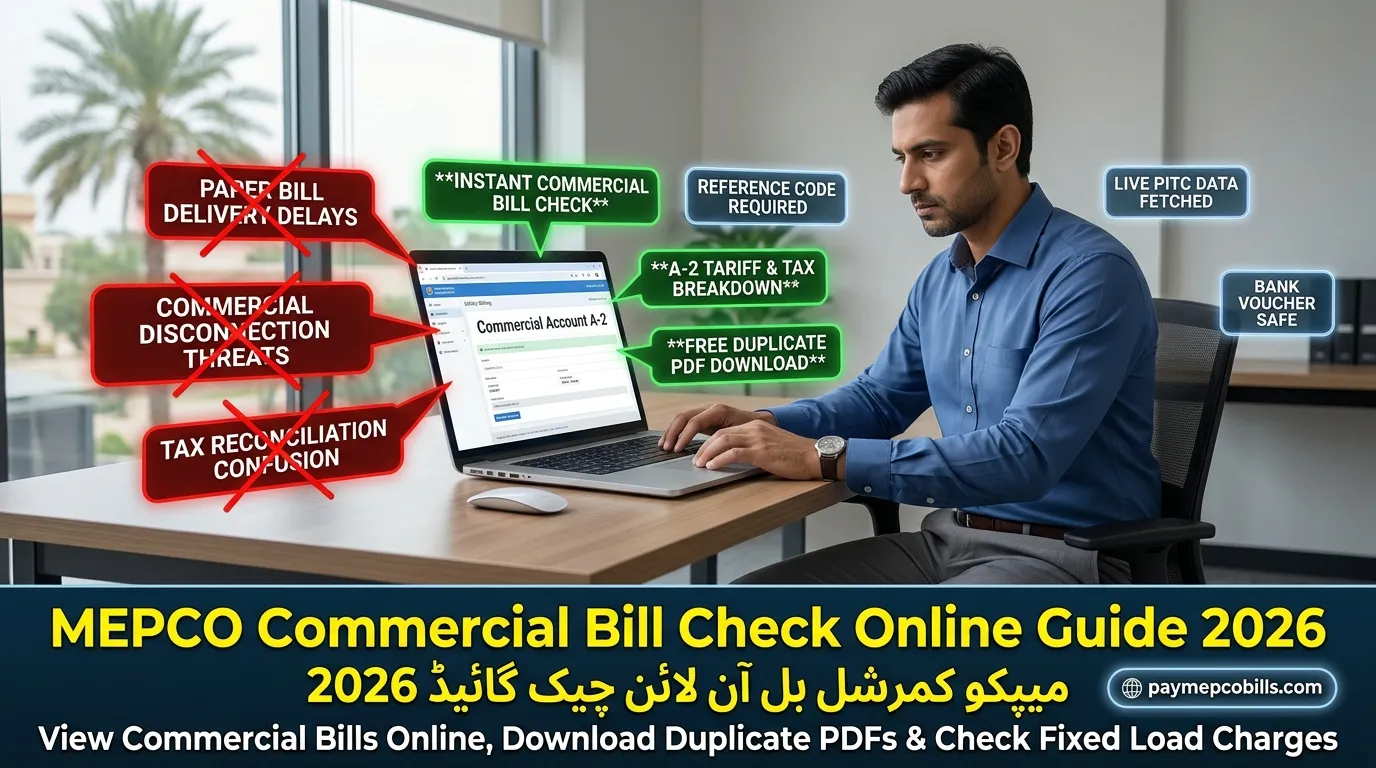
Running a retail store, office, or commercial pl aza across South Punjab requires tight control over monthly overhead costs, with electricity expenses sitting right at the top. Waiting around for paper utility statements to arrive by courier often leads to missed deadlines, unexpected late payment surcharges, and unnecessary stress during tax reconciliation. Checking your MEPCO Commercial Bill online solves these bottlenecks immediately by giving business owners instant digital access to live billing records, peak-hour unit consumption snapshots, fixed load fees, and downloadable PDF duplicates. Whether you manage a single neighborhood shop or multiple commercial connections across Multan, Bahawalpur, and Dera Ghazi Khan, mastering digital verification keeps your cash flow predictable. This practical guide walks you through instant online lookup methods, commercial tariff breakdowns, surcharge calculations, and smart payment habits for 2026.
Understanding Commercial Tariff Categories and Billing Structures
Unlike domestic accounts, business connections follow specialized NEPRA regulatory rules designed for higher daytime power demand.
Key structural features of commercial electricity accounts include:
- A-2 Commercial Tariff Classification: Applies to retail shops, clinics, private offices, restaurants, and small commercial establishments operating across South Punjab.
- Two-Part Tariff Billing: Connections with a sanctioned load exceeding 5 kW are billed under a two-part structure combining fixed monthly capacity charges per kilowatt with variable per-unit energy rates.
- Time-of-Use (TOU) Peak Metering: Three-phase commercial meters record separate readings for peak evening hours and off-peak daytime hours, applying higher unit rates during peak grid demand.
- Commercial Tax & Duty Frameworks: Business utility statements incorporate Commercial General Sales Tax, Advance Income Tax under Section 235, and municipal electricity duties.
Knowing your classification helps verify that applied tariff rates match your approved load.
Read More About MEPCO Three Phase Meter Replacement Cost 2026
How to Check Your MEPCO Commercial Bill Online Step-by-Step
Retrieving your monthly utility statement digitally takes less than sixty seconds from any smartphone, tablet, or office desktop computer.
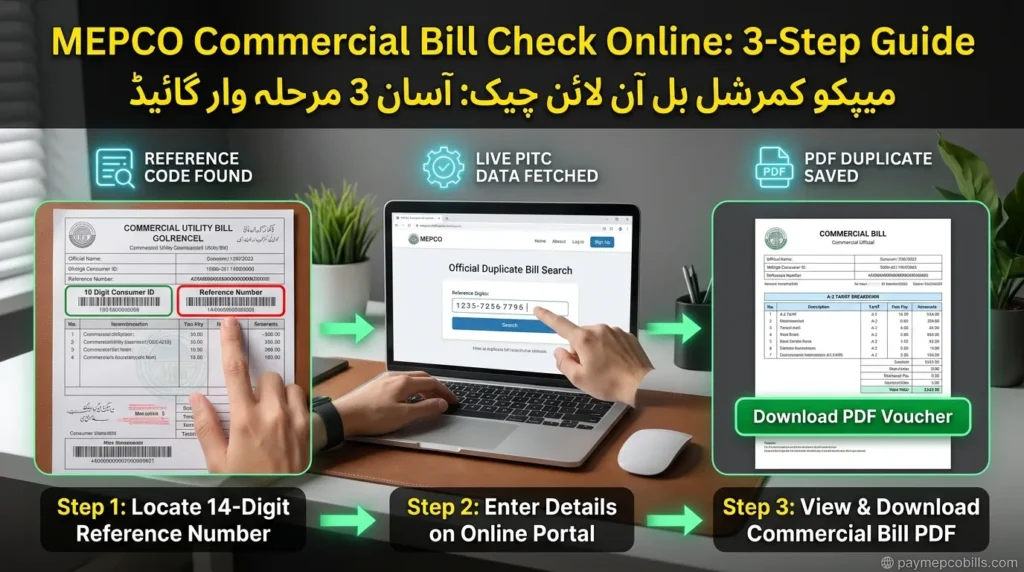
Follow this straightforward verification workflow:
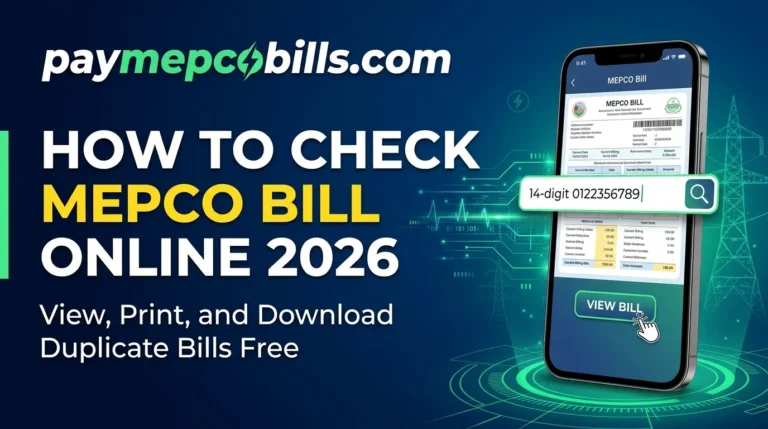
Step 1: Locate Your 14-Digit Reference Number
Grab any previous month’s printed utility statement or saved payment receipt. Look at the top-left or top-right header box to find your unique 14-Digit Reference Number or 10-Digit Consumer ID.
Step 2: Open the Digital Duplicate Bill Portal
Launch your web browser and navigate to an authorized utility bill checking portal connected to central PITC servers. Choose whether you want to search via Reference Number or Consumer ID.
Step 3: Enter Your Account Digits Without Spaces
Type your 14-digit reference code carefully into the search input field. Avoid adding hyphens, slashes, or blank spaces between digits, and select the ‘U’ (Urban) or ‘R’ (Rural) indicator if prompted.
Step 4: Inspect Your Live Billing Statement
Press the search button to display your current MEPCO Commercial Bill on screen. Verify the payable amount before the due date, amount after the due date, meter reading photograph, and unit consumption history.
Step 5: Download or Print Your Duplicate PDF Copy
Click the print or save button to download a crisp PDF duplicate voucher. Keeping this digital copy streamlines bookkeeping, tax filing, and online banking payments.
Read More About MEPCO Burnt Meter Replacement Application 2026
Decoding Fixed Charges, Fuel Adjustments, and Commercial Taxes
Many business owners notice payable totals exceed simple unit charges. Understanding itemized surcharges prevents confusion during monthly audits.
Primary billing components include:
- Fixed Capacity Charges (kW Load): A mandatory monthly charge calculated on your total sanctioned kilowatt load, billed even during months when your shop or office remains closed.
- Fuel Price Adjustment (FPA): A fluctuating per-unit surcharge reflecting changes in international fuel prices used for thermal power generation during prior billing cycles.
- Quarterly Tariff Adjustment (QTA): Periodic regulatory adjustments covering power transmission, capacity payments, and distribution network maintenance.
- Advance Income Tax & Commercial GST: Statutory taxes collected on behalf of the Federal Board of Revenue (FBR), which registered businesses can claim as adjustable tax credits when filing annual returns.
Reviewing these line items ensures complete transparency and helps your accountant separate operational energy expenses from recoverable tax deductions.
Smart Strategies to Lower Your Monthly MEPCO Commercial Bill
Controlling MEPCO Commercial Bill electricity costs does not require shutting down essential business operations; instead, smart load management delivers immediate savings.
Implement these proven cost-reduction habits:
- Shift Heavy Equipment to Off-Peak Hours: Schedule high-load operations such as commercial refrigeration defrosting, water pumping, packaging machinery, and battery charging outside evening peak hours.
- Audit Your Sanctioned Load Regularly: If your business downsized equipment or operates well below its sanctioned kilowatt limit, applying for a load reduction lowers your mandatory monthly fixed charges.
- Upgrade Lighting and HVAC Systems: Replacing conventional fluorescent tubes and older non-inverter air conditioners with modern inverter HVAC units and LED fixtures cuts daytime unit consumption by up to 35 percent.
- Explore Commercial Solar Net Metering: Installing a grid-tied solar PV system allows daytime business consumption to run directly on solar energy while exporting surplus units back to the grid for credit.
Applying even two of these practical adjustments noticeably reduces your monthly utility expenditure over consecutive billing cycles.
How to Avoid Late Surcharges and Commercial Disconnections
A single missed due date on a commercial utility account triggers a 10 percent Late Payment Surcharge (LPS) and puts your business at risk of abrupt power disconnection.
Protect your business continuity with these simple routines:
- Check Bills Early in the Billing Cycle: Make a habit of checking your digital commercial statement online around the 10th to 15th of every month rather than waiting for paper delivery.
- Enable Digital Banking Auto-Alerts: Save your 14-digit commercial reference number in JazzCash, EasyPaisa, or your corporate bank portal to receive instant notifications the moment a new bill is generated.
- Maintain a Digital Archive of Paid Receipts: Store downloaded PDF bills alongside digital transaction receipts in a dedicated cloud folder so you have instant proof of payment during sub-divisional inspections or property audits.