
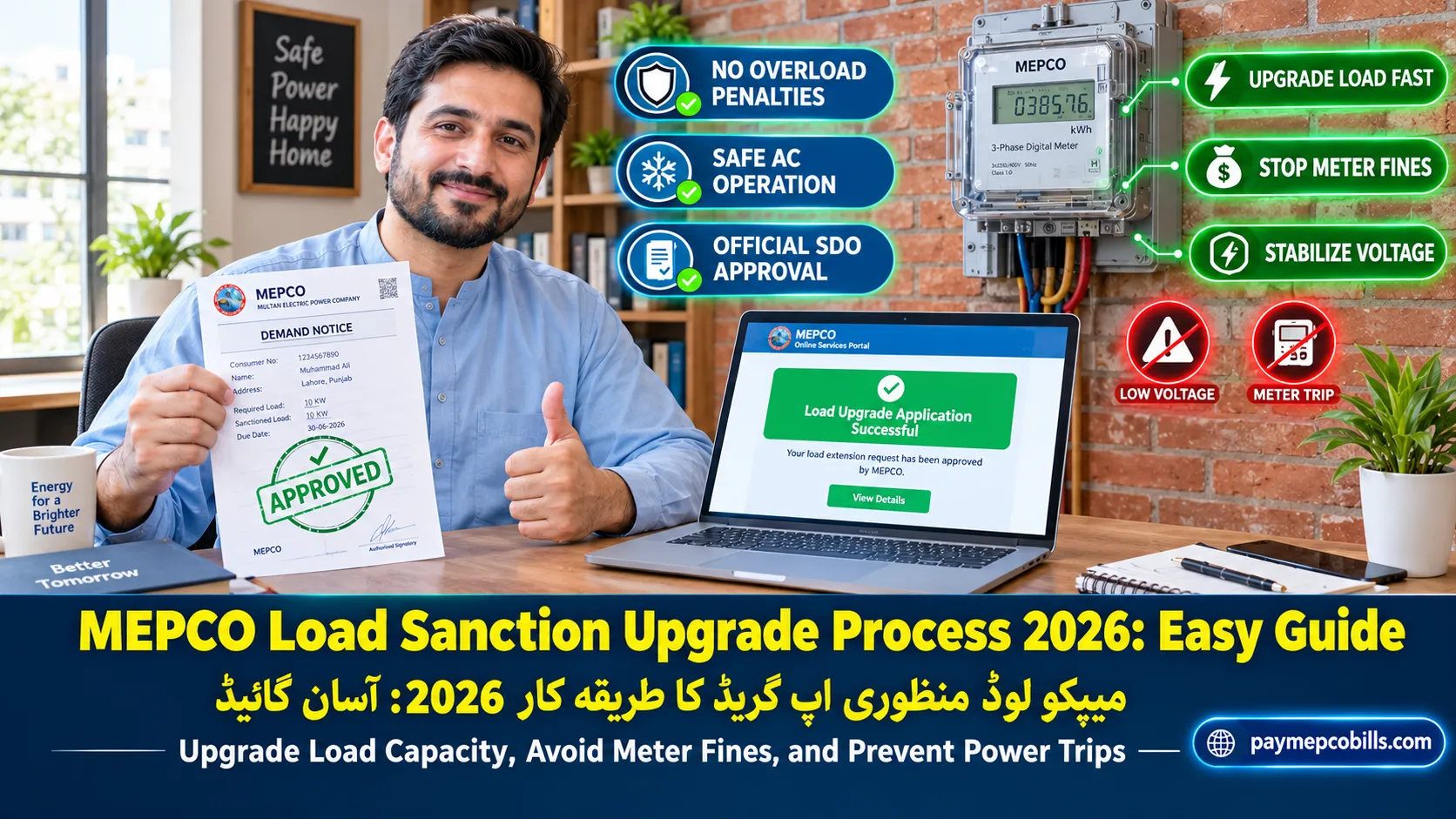
MEPCO Load Sanction Upgrade Process 2026 Guide
Upgrading sanctioned electricity load prevents unexpected meter burnouts, voltage fluctuations, and heavy unauthorized usage penalties across South Punjab households. Multan Electric Power Company allows residential, commercial, and industrial consumers to increase their official connected load capacity through a streamlined application system. Understanding the complete MEPCO Load Sanction Upgrade Process 2026 ensures your property safely accommodates additional air conditioners, heavy machinery, or commercial equipment without risking sudden disconnection. Following official procedures protects electrical infrastructure, stabilizes voltage levels, and maintains lawful billing records. This comprehensive guide details online registration steps, required documentation, demand notice fee calculations, physical meter inspection, and practical solutions to complete your application smoothly.
Why Sanctioned Load Capacity Matters for Every Consumer
Every electricity connection is assigned a specific sanctioned load limit based on the initial application submitted during meter installation. When property owners install new electrical appliances without informing the utility company, connected usage exceeds approved safety thresholds.
Key reasons to officialize your increased power demand include:
- Preventing Meter Burnout Accidents: Overloading electrical lines generates excess heat, causing service drop cables and energy meters to catch fire or fail completely.
- Avoiding M&T Overload Penalties: Metering and Testing teams inspect premises regularly, issuing heavy financial fines whenever actual consumption surpasses sanctioned capacity limits.
- Ensuring Stable Voltage Distribution: Updating official records allows distribution engineers to upgrade local transformers, protecting appliances against damaging low-voltage drops.
- Enabling Smooth Tariff Adjustments: Maintaining accurate capacity records ensures fair tariff slab applications without administrative billing disputes or sudden service suspension notices.
Initiating an official capacity revision safeguards your property equipment while keeping your utility account compliant with regional power distribution regulations.

Key Steps in the MEPCO Load Sanction Upgrade Process 2026
Transitioning to a higher kilowatt rating requires submitting verified consumer data through the official portal or local sub-divisional offices.
The standard registration workflow consists of these essential stages:
- Document Verification: Preparing property ownership deeds, active CNIC copies, and the latest paid electricity bill statement for administrative screening.
- Application Submission: Registering load enhancement details on the Electricity New Connection (ENC) portal or submitting physical forms directly to your local Sub-Divisional Officer.
- Site Inspection by Field Staff: Technical survey conducted by sub-divisional linemen to evaluate service wire gauge, transformer capacity, and safety clearances.
- Demand Notice Issuance: Generating an official fee payment voucher based on the total kilowatt enhancement requested by the applicant.
- Equipment Installation and Final Sanction: Replacing existing meters or service drop cables upon payment verification and updating central consumer database records.
Adhering strictly to the MEPCO Load Sanction Upgrade Process 2026 guarantees smooth administrative processing, timely site inspections, and hassle-free capacity approval.
Read More About MEPCO Bill Payment Through JazzCash EasyPaisa 2026 Guide
Essential Documents Required for Load Enhancement
Submitting complete, clear documentation during initial registration speeds up processing times and prevents application rejection by scrutiny officers.
Ensure you gather the following verified credentials before starting your application:
- Attested CNIC Copy: Valid national identity card copy of the registered electricity account owner.
- Proof of Property Ownership: Copy of registry, allotment letter, or legal property tax assessment confirming ownership rights.
- Recent Paid Electricity Bill: Clear copy of the previous month’s bill showing zero outstanding arrears on the reference number.
- Test Report from Licensed Electrician: Technical certificate verifying internal wiring safety and total connected load calculation signed by an authorized electrical contractor.
- No Objection Certificate (NOC): Required from property owners if a tenant or commercial lessee requests load enhancement on rented premises.
Having these documents ready ensures your submission moves rapidly through field verification channels without administrative delays.
Read More About MEPCO Bill SMS Alert Registration 2026
Demand Notice Fees and Tariff Calculations
Upgrading connected capacity involves official charges meant to cover equipment upgrades, service line reinforcement, and administrative processing.
The cost structure depends on several technical factors:
- Kilowatt Rate Categories: Charges are calculated per additional kilowatt (kW) requested, with distinct rate structures for single-phase and three-phase meters.
- Meter Replacement Costs: If your requested capacity exceeds 5 kW, single-phase meters must be replaced with three-phase digital meters, adding equipment cost components.
- Security Deposit Adjustments: Upgrading load increases the required advance security deposit held by the utility company, which is added to your demand notice total.
- Service Line Upgrade Fees: If existing service drop wires cannot handle the higher current load, additional line material charges apply.
Paying your demand notice at designated bank branches or through verified mobile wallets triggers immediate work orders for field staff installation.
Single Phase to Three Phase Conversion Workflow
When residential or commercial power requirements exceed 5 kilowatts, converting from a single-phase connection to a three-phase system becomes mandatory.
Follow these operational requirements during phase conversions:
- Submit Load Calculation Sheet: Calculate total wattage for all running appliances, including inverter air conditioners, water pumps, and heavy motors.
- Obtain Wiring Approval: Ensure internal property wiring is split evenly across three distinct phases to prevent neutral wire heating or phase unbalance.
- Pay Phase Enhancement Demand Notice: Clear all equipment and security differential charges listed on the official payment voucher.
- Schedule Meter Replacement: Coordinate with field staff to remove the old single-phase meter and install the new three-phase electronic meter.
Completing this structural conversion under the MEPCO Load Sanction Upgrade Process 2026 ensures continuous power delivery during heavy usage months.
Read More About How to Extend MEPCO Bill Due Date 2026 Get Extra Time
Resolving Application Delays and Inspection Issues
If your capacity upgrade application encounters delays during site surveys or document screening, specific remedial steps can resolve the bottleneck.
Troubleshoot common application obstacles using these measures:
- Clear Outstanding Arrears: Applications remain paused if any previous billing arrears exist on the target reference number or neighboring connections owned by the same applicant.
- Address Transformer Capacity Limits: If your local distribution transformer is fully loaded, request a transformer upgrade through your SDO office before reapplying.
- Verify Wiring Certificate Authenticity: Ensure your electrician test report is issued by a recognized contractor to avoid rejection during technical scrutiny.
Taking proactive steps during field surveys ensures your requested capacity upgrade receives final sanction without unnecessary administrative holds.




2 Comments