

MEPCO Unit Price per Unit Rates 2026 Calculate Bill Costs Guide
Managing household power budgets across South Punjab requires a clear understanding of current electricity tariffs. Multan Electric Power Company applies structured consumer schedules to calculate monthly utility expenses across residential, commercial, and industrial connections. Understanding your official MEPCO Unit Price helps property owners monitor daily consumption patterns, audit monthly charges, and identify billing discrepancies before making bank payments. Utility rates depend on protected status, slab tiers, and peak demand windows. This comprehensive guide breaks down unit slab categories, fuel cost adjustments, fixed capacity charges, and government taxes to keep your electricity account billing fully transparent and accurate.
Understanding Utility Billing Tariff Structures
Distribution companies divide electricity consumers into structured categories based on sanctioned load capacity and monthly consumption volume. The primary objective of this classification is to provide targeted subsidies to low-income households while charging standard commercial rates to larger consumers.
Power distribution tariffs are divided into distinct billing categories:
- Protected Residential Consumers: Household accounts consuming under 200 units consistently for six consecutive months receive subsidized per-unit pricing.
- Unprotected Residential Consumers: Accounts exceeding 200 units enter standard progressive pricing slabs without government subsidy support.
- Commercial Connections (A-2): Business outlets, shops, and corporate offices operating on fixed load charges and non-subsidized unit rates.
- Agricultural and Industrial Tariffs: Special categories tailored for high-demand tube wells, manufacturing factories, and processing plants.
Knowing your exact consumer category and the current MEPCO Unit Price associated with your slab allows you to project monthly utility expenses accurately.
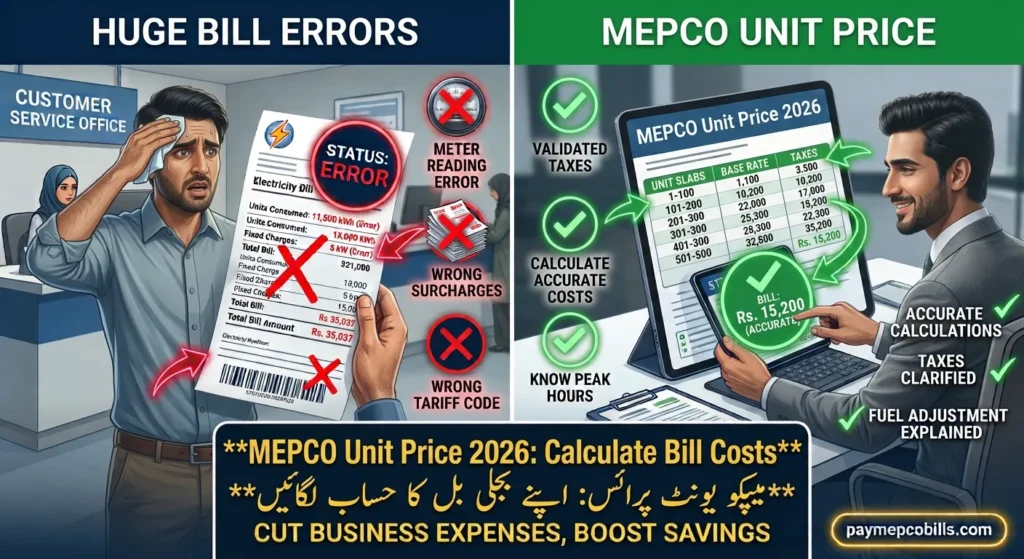
Breakdown of Residential Unit Slabs
Residential electricity billing relies on a progressive slab system. As your total monthly consumption increases, the cost per individual MEPCO Unit Price rises across higher consumption brackets.
1. Protected Consumer Tiers (1 to 200 Units)
Low-volume residential consumers who maintain low consumption levels qualify for protected status. The base cost per unit in these lower slabs remains significantly lower to ease financial burdens on low-income families.
2. Unprotected Consumer Tiers (1 to 700+ Units)
Once a household exceeds the 200-unit threshold or fails to maintain protected status, higher progressive rate tiers apply. Unprotected slabs are structured as follows:
- 1 to 100 Units: Initial base rate tier for standard unprotected domestic connections.
- 101 to 200 Units: Secondary progressive tier with moderate cost escalation.
- 201 to 300 Units: Mid-level consumption bracket reflecting full generation costs.
- 301 to 700 Units: High-volume domestic bracket subject to additional regulatory surcharges.
- Above 700 Units: Maximum residential unit pricing bracket carrying full capacity and distribution overheads.
Checking your paper bill against the official MEPCO Unit Price schedule ensures your account statement reflects your actual bracket tier.
Impact of Peak and Off-Peak Billing Hours
To balance electrical grid stability during periods of high national energy demand, distribution authorities implement Time-of-Use (TOU) billing for three-phase connections. Consumers equipped with TOU meters pay different unit rates depending on the time of day electricity is consumed.
Peak demand hours generally follow seasonal schedules:
- Summer Season (April to September): Peak hours operate between 6:30 PM and 10:30 PM daily.
- Winter Season (October to March): Peak hours operate between 5:00 PM and 9:00 PM daily.
During peak windows, the per-unit rate increases significantly compared to standard off-peak operating hours. Shifting high-load appliances like air conditioners, water pumps, and iron presses outside designated peak hours drastically reduces your overall MEPCO Unit Price expenses on monthly invoices.
Taxes, Duties, and Surcharges on Electricity Bills
The base energy charge calculated from your meter reading represents MEPCO Unit Price only a portion of your total payable utility bill. Several mandatory taxes and regulatory adjustments are added to every billing cycle.
Key additional charges include:
- Fuel Price Adjustment (FPA): Variable monthly adjustments authorized by NEPRA to reflect changes in global fuel import costs for power generation.
- Quarterly Tariff Adjustment (QTA): Periodic tariff revisions distributed across quarters to cover transmission and distribution network updates.
- General Sales Tax (GST): Standard government tax applied to total power generation and capacity charges.
- Electricity Duty & TV Fee: Fixed administrative duties collected on behalf of provincial governments and national broadcasting networks.
- Advance Income Tax: Tax levied on non-filer accounts whose monthly bill total exceeds prescribed threshold limits.
Evaluating these additional line items alongside the baseline MEPCO Unit Price prevents confusion when reviewing monthly statement increases.
Step-by-Step: How to Calculate Your Bill Costs
You can easily estimate your monthly bill total at home by following a simple MEPCO Unit Price step-by-step mathematical calculation process:
- Record Total Consumed Units: Subtract last month’s previous reading from the current active reading displayed on your meter screen.
- Identify Your Slab Status: Determine whether your account falls under protected or unprotected domestic schedules on your previous bill.
- Multiply Base Slab Rates: Calculate the base energy charge by multiplying units consumed in each applicable slab tier by its specific rate.
- Add Peak Hour Units: If using a three-phase meter, multiply peak and off-peak units by their respective rate categories.
- Include Taxes and Surcharges: Add applicable GST, FPA, QTA, and duty percentages to determine your total payable amount.
Auditing your calculated totals against the official MEPCO Unit Price guidelines helps you spot reading errors early.
Read More About MEPCO Meter Change Application 2026 Fast Online Process Guide
Resolving Billing Errors and Incorrect Tariffs
If your monthly bill appears excessively high due to incorrect reading multipliers, wrong slab application, or unrecorded solar net metering credits, take immediate corrective action.
Visit your nearest Sub-Divisional Office (SDO) or lodge an online tracking ticket through the Customer Complaint Management System (CCMS) portal. Present physical meter screen photographs, recent paid bill receipts, and consumer CNIC copies. Authorized staff will inspect meter records and issue a revised bill statement reflecting the accurate MEPCO Unit Price structure.



2 Comments